Last updated 2026-07-26
TL;DR
There's no single 'mobile bar license.' You'll typically need a caterer's permit, special event permit, or a temporary/per-event license from your state ABC authority, since most states license alcohol to a fixed premises. Some states (like Texas and California) have specific mobile beverage cart or caterer's authorization categories. Confirm with your state ABC authority before you book a single event.
Is there an actual 'mobile bar license' or is that a myth?
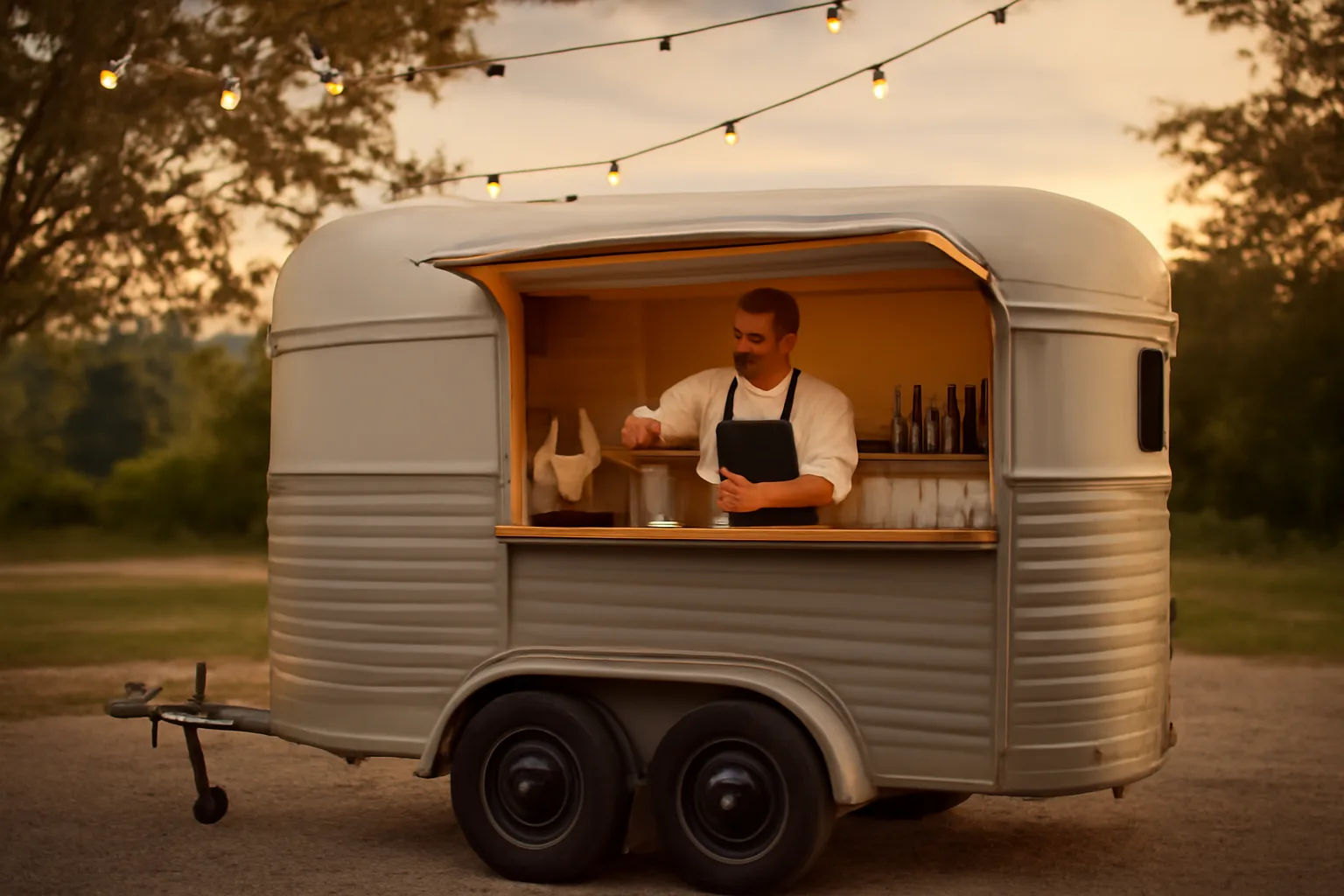
Mostly a myth, at least as a single named license. Almost every state's alcohol code was written around a fixed physical premises, a bar, restaurant, or package store with four walls and an address on the license. A mobile bar (a trailer, a converted horse trailer, a vintage truck, a tap wall you roll into a barn wedding) doesn't fit that model cleanly, so states have bolted on workarounds rather than building a clean new category. What you'll actually apply for is usually one of three things: a caterer's permit or caterer's authorization attached to an existing liquor license, a special event permit or temporary permit tied to a specific date and venue, or, in a handful of states, a purpose-built mobile bar/beverage cart license. Which one applies depends entirely on your state, and sometimes your county or city layers on its own permit on top. The practical result: your 'mobile bar liquor license' is really a bundle of permissions, one for the alcohol itself, often another for the vehicle or trailer (health department, fire marshal, sometimes DMV if it's towed on public roads), and sometimes a third for the specific event or venue. Treat it as a project with three tracks, not one form. For general background on how state licensing categories work, see our license types overview.
How do I get a liquor license for a mobile bar, step by step?
Start by figuring out your business model, because it drives everything else. A mobile bar that only works private events (weddings, corporate parties) where the host or venue already has, or doesn't need, its own license is a different animal than a mobile bar that sells drinks directly to the public at festivals and street fairs. 1. Identify your state ABC agency and read its catering/special event rules first, before you spend money on a trailer build-out. Every state has one; find yours through the TTB's list of state alcohol beverage control agencies [1]. 2. Decide your legal structure and get your business entity, EIN, and any required food service or health permits lined up, since most ABC applications ask for these upfront. 3. Apply for the base authorization your state requires: a caterer's permit, a special event/temporary permit, or a mobile vendor license, depending on category (see the state examples below). 4. For each specific gig, many states require you to notify the ABC agency or file an event-specific rider, sometimes with lead times of two to four weeks. Confirm your state's notice window with your ABC authority; these vary and change. 5. Line up host liquor liability insurance (often required, and smart even when it isn't) and confirm local permits: fire marshal sign-off for propane or generators, health department food/beverage permits, and local special event or noise permits from the city or county. 6. Keep every server TIPS/TAM/ServSafe-certified per your state's mandatory training law, since server certification requirements apply on a mobile bar exactly like they do at a fixed bar. If you're planning this against a lease and an opening date for a fixed location too (some mobile bar operators are building toward a brick-and-mortar), our State Liquor License Roadmap is a $199 one-time tool that back-plans the whole license timeline from your target open date, so you're not discovering a 90-day wait at week six.
How can I get a liquor license if I only work weddings and private events?
This is the most common mobile bar model, and it's often the easiest path, but 'easiest' still means real paperwork. Two structures dominate: First, the venue or host already holds the liquor license (a winery, a private estate with its own permit, a country club) and you're hired purely as bartending labor, pouring alcohol the host or venue already owns and is licensed to serve. In many states this requires no separate alcohol license for you at all, just liability insurance and, in states with mandatory server training, certified bartenders. But this varies a lot by state; some states still require the person physically pouring to hold a permit regardless of who owns the liquor. Second, you provide the alcohol yourself as part of the package. This is where you almost certainly need a caterer's permit or special event permit, because you're now the one purchasing and serving alcohol to the public (even a semi-private one). Texas, for example, has a Caterer's Permit (Type CE) that lets license holders serve alcohol at locations other than their permitted premises, filed through the Texas Alcoholic Beverage Commission [2]. California requires a Caterer's Permit endorsement on certain license types (like a Type 47 or Type 48) issued by the Department of Alcoholic Beverage Control, which allows off-site service at a specific address for a specific date [3]. Either way, ask upfront: who is buying the alcohol, and whose license covers it. That single question determines almost everything else in your application.
How much is a liquor license for a mobile bar business?
There's no flat number, because you're not paying for one license, you're paying for a stack of permits that varies by state and by how many events you run per year. Here's the honest range of what to budget for, using real published fee structures where they exist. Caterer's permits and endorsements: California's ABC lists specific fee schedules by license type on its official fee page, with catering permit and license fees varying by category and county population tier [3]. Texas's Caterer's Permit (CE) fee schedule is published by TABC and varies by permit type and municipality population [2]. Neither state publishes a single 'mobile bar' number, because it depends on your underlying license class. Special event or temporary permits: many states charge a per-event fee, often in the range of small double digits to a few hundred dollars per event, but confirm with your state ABC authority since these numbers shift and some states charge per day. Federal layer: if you're manufacturing, blending, or otherwise acting outside straight retail sale (rare for most mobile bars, but common if you're also bottling cocktails ahead of time), you may need a TTB basic permit, which itself has no application fee but requires background and premises review [4]. Don't forget the non-alcohol costs that often exceed the license fee itself: liquor liability insurance (often several hundred to a couple thousand dollars a year depending on coverage and event volume), local health permits, fire marshal inspections for propane/generators, and any local business license. Budget the license fee as the smallest line item, not the biggest.
How much is a liquor license in Florida for a mobile or catering operation?
Florida runs its alcohol licensing through the Division of Alcoholic Beverages and Tobacco (ABT), and it's one of the more quota-restrictive states for full liquor (spirits) licenses. Florida's quota licenses, tied to county population under section 561.20, Florida Statutes, are capped and often trade on a secondary market for far more than the state's face-value fee, sometimes tens of thousands to well over a hundred thousand dollars depending on the county [5]. But a mobile bar or caterer usually isn't chasing a quota license at all. Florida issues a Caterer's License (a specific license class under its beverage law) that lets a licensed caterer serve alcohol at events away from a fixed premises, and Florida also allows temporary licenses tied to specific special events. The state fee schedule for these categories is published by the ABT and varies by license series and, in some cases, county; confirm the current figure with Florida's ABT directly since fee schedules get revised [6]. So if you've seen a number online claiming 'Florida liquor license costs $X,' be skeptical, because Florida licenses several different alcohol categories (beer/wine only, quota spirits, caterer, special event) at different fees, and the quota license secondary-market price gets conflated with the state application fee constantly. For a mobile bar working weddings and private events in Florida, you're almost certainly looking at the caterer's license or special event permit track, not a quota liquor license. Our Florida guide breaks down the state's license classes in more detail.
Can you serve alcohol without a liquor license at all?
Only in narrow situations, and it's easy to get this wrong. If you or your event is truly private (a genuinely closed guest list, no sale or exchange of money for drinks, no public admission), many states don't require a license because there's no 'sale' happening in the legal sense. This is why a fully hosted open bar at a private wedding, with the couple footing the bill and no cash changing hands at the bar, often doesn't trigger licensing the same way a cash bar does. The moment money changes hands for a drink, directly or indirectly (a ticket price that includes drinks, a cash bar, a per-drink charge, even a suggested donation in some states' interpretations), most states treat that as a sale requiring licensure. This is the single most common mistake mobile bar operators make: assuming 'private event' automatically means 'no license needed.' It doesn't, if there's a sale. Operating without a required license is a real legal risk, not a technicality. Most states classify unlicensed alcohol sales as a criminal offense (often a misdemeanor for a first offense, escalating with volume or repeat violations), on top of civil penalties and the practical risk of losing your liability insurance coverage, since most host liquor policies exclude unlicensed activity entirely. If you're unsure whether your event model counts as a sale, ask your state ABC agency directly before the event, not after.
How do I get a bartending license, and do my staff need one?
'Bartending license' is a common phrase but a slightly misleading one. Most states don't license individual bartenders the way they license a business; instead they require alcohol server training certification, sometimes state-mandated, sometimes optional but insurance-required. What's usually required: a training course (commonly TIPS, ServSafe Alcohol, or a state-specific program) that covers checking ID, recognizing intoxication, and refusal of service, followed by a card or certificate, often valid for two to three years. A few states, including Oregon and Utah, have mandatory statewide server permit systems with their own state-run exam and card (Oregon's OLCC requires a Service Permit for anyone who sells, serves, or checks ID for alcohol, per its administrative rules ). Other states leave training optional at the state level but individual counties, cities, or your insurer may require it anyway. For a mobile bar, get every pourer certified before your first event, not after a claim. It's cheap (often $10 to $40 per person for an online course) compared to the liability exposure of an uncertified bartender over-serving at an event you're legally responsible for.
Can anyone take the bar exam, and does that have anything to do with a liquor license?
No connection at all, and this mix-up happens often enough to address directly: 'the bar exam' refers to the licensing exam attorneys take to practice law, administered state by state and, for most jurisdictions, requiring a JD from an ABA-accredited law school plus passing character and fitness review. It has nothing to do with alcohol licensing. Eligibility to sit for the bar exam varies by state bar admission rules; most require graduation from an accredited law school, though a small number of states (California among them, under specific rules) allow alternative paths like law office study. If you landed here searching 'bar exam' while researching a mobile drink-serving business, you want the sections above, not a law degree. For actual bar exam eligibility questions, your state's bar association (see our California bar and Florida bar pages) is the right resource, not your state's alcohol beverage control agency.
What permits does a mobile bar need beyond the liquor license itself?
The alcohol permit is one piece. Depending on your city and county, expect to also handle: a local business license or mobile vendor permit, health department permits (many jurisdictions classify a mobile bar serving mixers, garnishes, or ice as a limited food service operation requiring inspection), fire marshal approval if you're running propane, generators, or open flame near the trailer, and a special event permit from the city if you're setting up on public property or a public street. If your mobile bar tows on public roads, confirm your state's DMV or DOT trailer registration and weight requirements too, separate from anything alcohol-related. None of this is alcohol licensing, technically, but missing any one of these can shut down an event morning-of just as fast as missing the liquor permit itself, so build your pre-event checklist around all of them together, more than the ABC piece.
How long does it take to get a mobile bar liquor permit approved?
Timelines vary enormously by state and by permit type, and this is the area where operators most often get burned by planning too tight. A per-event special event permit in some states can be issued in as little as a week or two if your paperwork is clean. A caterer's permit or endorsement attached to a full license, especially your first one, commonly takes several weeks to a few months, since it often runs through the same background check and local notice process as a standard on-premise license. If you're building a mobile bar business from scratch (new entity, first-time applicant, no existing license to attach a caterer's endorsement to), plan for the full timeline of a standard liquor license application in your state, not the shorter per-event add-on timeline. States publish estimated processing windows on their ABC agency pages, but 'estimated' is doing real work in that sentence, since local law enforcement background checks and any required public notice period can add weeks unpredictably. Back-plan from your first booked event, not the other way around. If your first paid gig is in ten weeks and your state's typical caterer's permit timeline runs eight to twelve weeks, you have almost no margin for a rejected application or a missing document. This is exactly the kind of timeline math our license roadmap tool is built to run for you against a real opening date.
State-by-state: how mobile bar licensing actually differs
| State | Mobile bar path | Key detail | |
|---|---|---|---|
| Texas | Caterer's Permit (Type CE) | Attached to an existing TABC permit holder; lets service off normal premises [2] | |
| California | Caterer's Permit endorsement | Added to qualifying license types (e.g., 47, 48) via ABC; event-specific address filing [3] | |
| Florida | Caterer's License / special event permit | Separate from quota spirits licenses under s. 561.20; confirm current fee with ABT [5][6] | |
| Oregon | OLCC Service Permit (individual) + business license | Mandatory individual server permit statewide, one of few states requiring this | |
| Most other states | Special event permit or caterer's rider, varies widely | No universal category; confirm directly with your state ABC agency | The pattern across every state: alcohol law was built around fixed premises, so mobile operators are routed through whatever adjacent category (catering, special event, temporary) the legislature bolted on. There is genuinely no shortcut around calling your specific state ABC agency and describing your exact business model (private events only versus public ticketed sales, owned alcohol versus client-provided, one-off versus recurring). See our state guides hub for individual state licensing breakdowns, and check comparisons if you're weighing which state to base a mobile bar business in. |
Frequently asked questions
How much is a liquor license for a mobile bar?
There's no single number. You're usually paying for a caterer's permit or special event permit fee (often small, sometimes a few hundred dollars per event) plus insurance, health permits, and possibly an underlying base license fee. Costs vary by state and license type, so confirm the current fee schedule with your state ABC authority before budgeting.
How do I get a bartending license?
Most states don't license individual bartenders as a business type; instead they require or recommend server training certification (TIPS, ServSafe Alcohol, or a state program). A few states, like Oregon, require an individual state-issued service permit. Check your state ABC agency's server training requirements, since they range from mandatory statewide to optional-but-insurer-required.
How can I get a liquor license for a mobile drink cart or trailer?
Contact your state ABC agency and ask specifically about caterer's permits, special event permits, or mobile vendor licenses, since 'mobile bar license' isn't a universal legal category. You'll typically need a base license or caterer's endorsement plus event-specific filings for each gig, along with local health and fire permits.
How do I get a liquor license in general?
You apply through your state's alcohol beverage control agency, choosing the license class that fits your business (on-premise, off-premise, caterer, special event). Applications typically require entity documents, background checks, local zoning sign-off, and sometimes a local notice period. Find your state agency through the TTB's state ABC directory and start there.
How do I obtain a liquor license as a first-time applicant?
Start with your state ABC agency's application guide, confirm which license class matches your business model, and gather your entity documents, lease or event agreements, and background check paperwork early. Many states also require local government sign-off (zoning, health department) before final state approval, so start those parallel tracks immediately, not after state approval.
Can anyone take the bar exam?
The bar exam is the attorney licensing exam, unrelated to alcohol licensing. Eligibility typically requires a JD from an accredited law school, though a small number of states allow alternative study paths. Check your specific state bar association's admission rules; this has no connection to getting a liquor license for a mobile bar or any other business.
How do I obtain a liquor licence (UK/Commonwealth spelling)?
If you're in the US, the process runs through your state ABC agency regardless of spelling preference. If you're actually asking about the UK or another Commonwealth country, that's a different legal system (a premises licence under the UK's Licensing Act 2003) and outside US state ABC processes covered here; check your local licensing authority instead.
How much is a liquor license in Florida?
It depends heavily on license type. Florida's quota spirits licenses, capped by county population under s. 561.20, often resell for tens of thousands of dollars or more on the secondary market, far above the state's base fee. Caterer's licenses and special event permits, which most mobile bars use, run on a separate, generally lower fee schedule set by Florida's ABT; confirm the current figure directly.
How much is a liquor licence in Florida for a caterer or mobile operation?
Florida's Caterer's License and special event permits are priced separately from the quota spirits license system, and the exact current fee is published by Florida's Division of Alcoholic Beverages and Tobacco. Fee schedules change, so confirm directly with the ABT rather than relying on older published figures.
Can you serve alcohol without a liquor license?
Only in narrow cases, typically a genuinely private event with no sale of alcohol (fully hosted, no cash bar, no ticket price covering drinks). The moment money changes hands for alcohol, directly or through a ticket price, most states require licensure. Operating without a required license risks criminal penalties and voids most liability insurance coverage.
Do I need a separate liquor license for every event my mobile bar works?
It depends on your state and your permit type. Some states let you hold one caterer's permit or license and file a simple event notice for each gig; others require a distinct special event permit filed separately for every date and location. Confirm your state's specific renewal and per-event filing rules with its ABC agency.
What's the difference between a caterer's permit and a special event permit for a mobile bar?
A caterer's permit or endorsement is usually attached to an existing liquor license and lets that licensee serve alcohol at approved off-site locations on an ongoing basis. A special event permit is typically a standalone, short-term authorization tied to one specific date and venue, often used by organizations or operators without a base license.
Sources
- Alcohol and Tobacco Tax and Trade Bureau, State Alcohol Beverage Control Agencies: Directory of state ABC agencies for finding the correct licensing authority
- Texas Alcoholic Beverage Commission, Caterer's Permit (CE): Texas Caterer's Permit (Type CE) allows service at locations other than the permitted premises
- California Department of Alcoholic Beverage Control, License Fees: California ABC publishes license and catering permit fee schedules by license type
- Alcohol and Tobacco Tax and Trade Bureau, Basic Permits: TTB basic permit requirements apply for certain alcohol production/handling activities beyond retail sale
- Florida Division of Alcoholic Beverages and Tobacco: Florida ABT issues caterer's licenses and special event permits separate from quota licenses
- Oregon Liquor and Cannabis Commission, Service Permits: Oregon requires an individual state-issued service permit for anyone who sells or serves alcohol